


Excavation is destruction. — a working rule of field archaeology
The archaeologist is unearthing not objects, but humans.— Mortimer Wheeler, Archaeology from the Earth, 1954
Even something unreadable is an image. It is hung on walls, it is inherited, it is protected, and it performs all the functions of a photograph without once fulfilling its only purpose as a photograph. One such image belonged to a family in the Bekaa, Lebanon for eighty years. Fifty-seven of those went by before anyone understood it, and each time, the process was performed with two vastly different methods. Each time, an attempt was made to recover a document, while the second time, the machine was asked to generate one. And both times, it reached the mind of people who have lived with the longing for more information about a face in it for decades.
The Negative, 1946
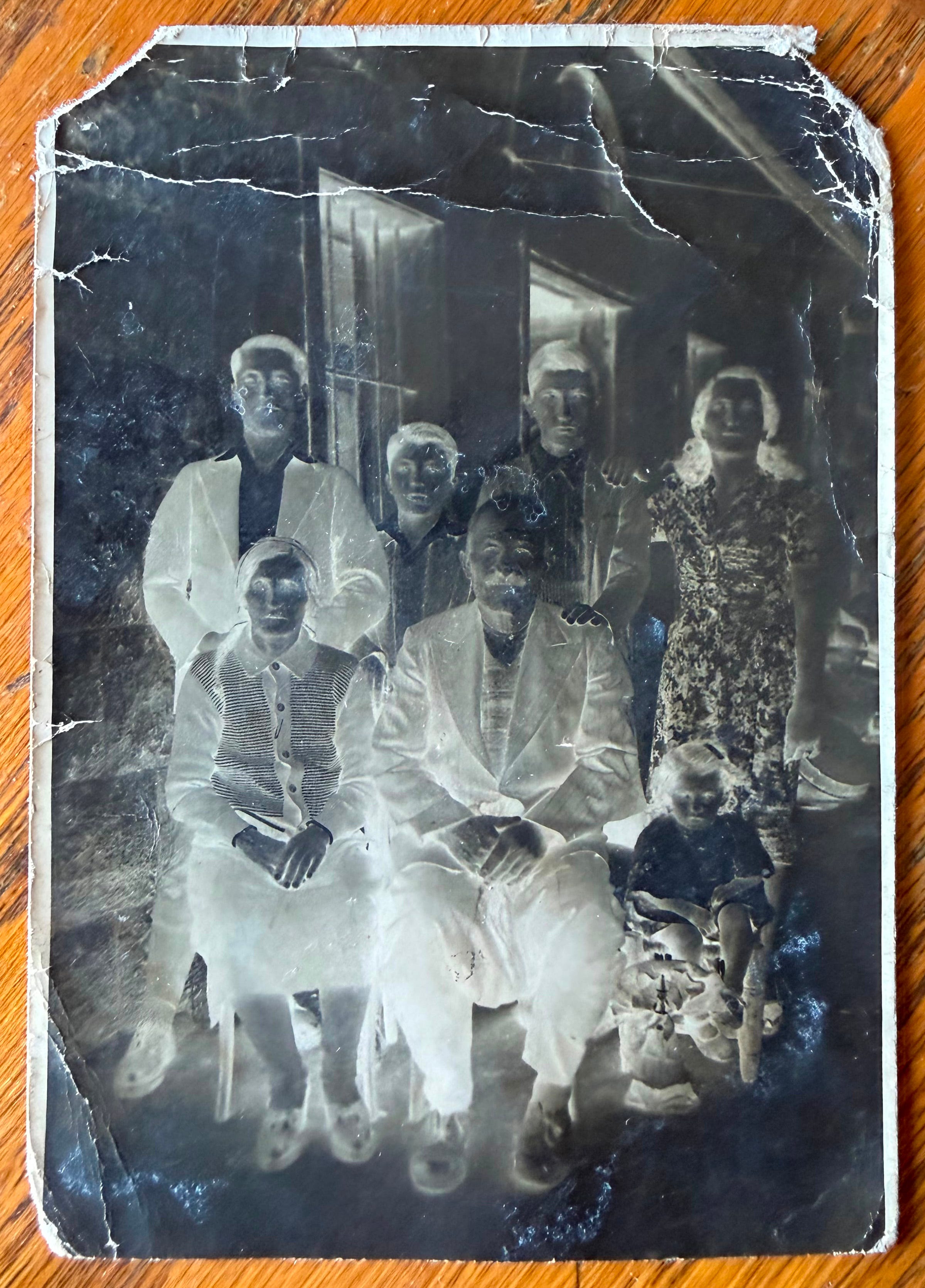
The object itself is almost invisible. Photographic paper, with pigment upon it, with torn edges, with a long crack that runs across the upper third of it like a fault line that has been breached. Seven people, and behind them, a stone house. A terrace, three open doors leading to an interior. On it, everything is backwards. The shadows which should fall away from the sun fall towards it. The white areas are black, while the blacks themselves have an unusual glow. Silver has taken hold of the one task a sheet of photographic paper is meant to perform, and has reversed it. This is not a photograph of a family. It is the photographic pre-requisite of one.
The family is the Nasrallah(s) of Kfar Mechkeh, in the West Bekaa in Lebanon. The object was acquired through Georges Nasrallah, my good friend, whose grandparents were the two seated in the center of the object and whose father is the young boy standing between his two brothers behind them. I would not have known anything about it had it not been for him, and what I know about what happened to it, who hung it there, and how people of that house regarded it is mostly what he knows about it.
The terrace, the stayha as we say in lebanese, runs across the width of the house, a gallery of the kind commonly built in that generation of Bekaa stone buildings. Seven silhouettes appear along the stayha, placed as usual for the family photos of the period, two seated at the center, four standing behind them with the smallest of the bunch standing in the middle of the group, one smaller silhouette sitting in the corner in a chair which seems too big for her. That is all that the negative gives away. No expression can be discerned, no clothing, no face that can be distinguished from others in the group. It is the same choreography found in thousands of Levantine family pictures taken in the same decades, and none of this is something chosen by anyone appearing in the picture. It is the concept of “habitus,” according to Bourdieu, and it defines the disposition given to people by the environment before they are ever free to make choices. [1] The way in which these seven stood, who sat and who remained standing, was defined long before the photographer used up his plates. A family with such specificity appears in such a general form, and all we can see for now is just the haze.
[1] Pierre Bourdieu, Un art moyen: essai sur les usages sociaux de la photographie, 1965, translated as Photography: A Middle-brow Art. Bourdieu found family photography to be group practice rather than private choice: families photograph the same occasions in the same arrangements, and the picture’s function is to confirm the group to itself and to those who receive it. Habitus is his term for the dispositions a position in the world installs in a person, reflexes that feel like instinct and are really a class, or a village, turned into second nature. The book’s other subject is photographic competence itself as an unevenly held possession: who owns a camera, who knows what can be done with what comes out of it, what a household is equipped to make of an image. That second half matters here more than the first.
It remains in this state for the reason of supply having nothing to do with meaning and everything to do with it. In 1946, a photographer making rounds among the villages of the Bekaa and Mount Lebanon from a circuit starting possibly in Aleppo or Damascus, visited Kfar Mechkeh, in the West Bekaa, with a view camera and glass plates which were getting over. He used up his stock of glass plates and rather than disappoint the family, he loaded paper instead of glass and exposed it directly, which is what the negative normally is, an intermediate state that is never supposed to be an object in itself. The photographer gave the family that day was a half-product of photography process, something that would normally be stored in a folder of any decent studio until the time of being printed from. There was no sitting for the next round.
A photographer traveling the above circuit would carry more than family pictures in his bag. Identification pictures for the documentation purposes required for crossing the border. Wedding pictures. A death picture, sometimes, for the family wanting the final image before the funeral. The same plates would work for all of it, and being cut off from his supplies halfway through the round was something far from unusual occurrence for his business.
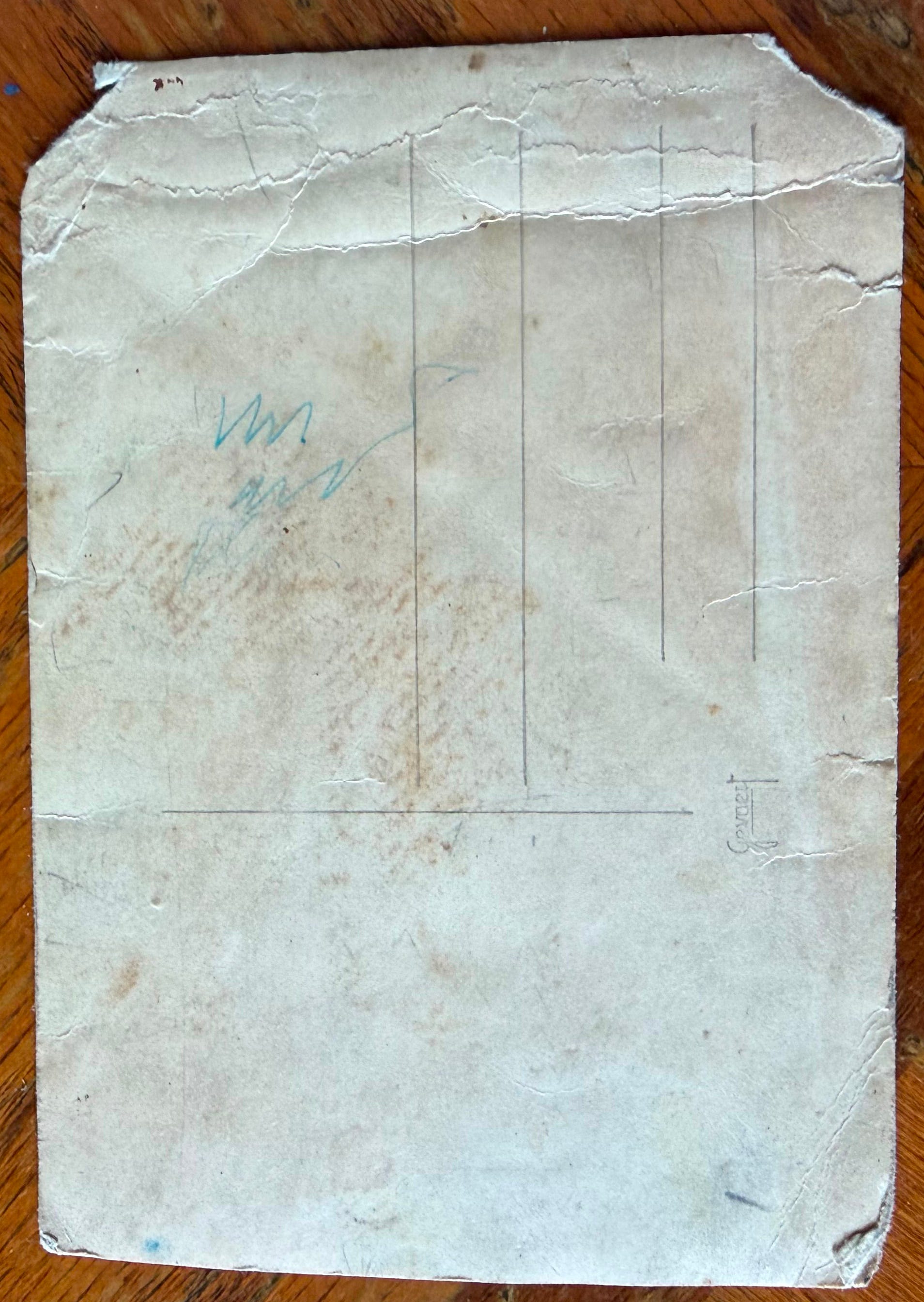
Almost nothing of it came from someone who was there. It is inference. Some of it comes from the information I received from Georges. Some of it can be inferred from the object itself, from the stamp on the back, weight and dimension of the sheet, the condition of the emulsion. The rest was inferred from the experience of analyzing other objects of the same kind taken in the same decade and in the same type of village and reasoning about that particular afternoon. Which is the task that occupies the second half of this essay done based on a small set of samples. Anyone else can examine the same objects and give me another account of how the circuit ran, how Gevaert plates made their way to the valley, whether the paper negatives were more common than I think. The story is arguable.
The date is its softest spot. There is no year on the reverse side. Georges dates it to 1946 based on seeing his father in the back row of the photograph, who was born in 1935 and is thus approximately eleven years old in the photograph, and counting back from there. I have adopted his number throughout this paper. And thus the afternoon is dated through the reading of a face, which is the sole procedure that the rest of this essay rejects, performed by the man most entitled to perform it, using the only data available.
The Frame and the Lamp
Glass is transparent. In the dark room, light shines through it once again, and through it a second time it becomes legible; printed onto paper, and that second pass changes the reversal into print. Paper is thicker and less transparent than glass, and this was traditionally considered the end of the story.
It is not the end. The analog method of printing a negative held on paper was contact printing, and this was known. A developed negative is laid emulsion side down against a second piece of unexposed photographic paper, perhaps another piece of Gevaert or any similar material. They both go into a contact printer or simply under a sheet of glass, held tightly together. Light for a few seconds, an enlarger without the negative placed in the carrier, or even just a lamp. Develop the second sheet and you will get a positive print.
This was how paper negatives were turned into prints from the nineteenth century until well after 1946 and beyond. Due to the thickness and low transparency of the paper as compared to film, the contact print was always preferred over the enlargement. It guaranteed the sharpness of the image. This was the standard way to deal with this kind of object, and it was standard that year.
And in this case, the photographer did not betray them. He offered them whatever was possible in his bag on that particular day : the negative which could not be printed right away. What they got is not an incomplete medium. This was an unfinished object which required a frame, a piece of paper, a lamp and few minutes to be finished, in Kfar Mechkeh or Zahlé, Marjeyoun or Beirut in this year or any other year after. But nobody ever did.
Kfar Mechkeh is a village of West Bekaa. The darkroom was probably located on the coast and the knowledge that there were images to take to the darkroom. What made its way up the valley was the photographer who was able to expose and not print and leave. The circuit worked like this. The cities kept the methods of finishing an image and provided the villages with the visit. A household which hands the unfinished half of an unseen process has no idea that the object is unfinished and has no reason to think that an unreadable object is just a closed object. An object that you believe is unable to be fixed is finished.
Somewhere in those first years the negative ceased to be the negative that waits for printing and became the photograph which they had.
The Grandparents’ Room
They keep it. They had no choice. It was not an aesthetic and faded souvenir. It was a document that is hardly readable if you analyze it coldly. Any stranger will see only ghosts and geometrical shapes on it, but not the people. Not the Nasrallah(s)
It was not hung where a guest can see it. It hung in their grandparents’ room, in Joryous and Hanneh’s room, pasted to the wall with barley dough. No frame, no glass, the paper against the wall plastered, glued to the wall again when the dough failed. Georges remembers it since 1968 and does not know how long it had been there before him.
And so the two individuals seated in the center of the photograph slept in the room with it. They saw it every day in a distracted way, much like anyone else would a photo hanging on the wall of their bedroom. This kind of looking, in decades’ worth, is its own brand of familiarity and has nothing to do with resolution.
With time, Hanneh forgot what it was. She believed the photograph to have been taken in America, showing her sister’s family that emigrated in the early part of the century. The woman in question is sitting in the center of the photograph, her hands folded in her lap, her husband by her side and her children surrounding her. There is nothing in the picture that would have suggested otherwise, and Hanneh was familiar with all the faces in it. She has been looking at a negative image of herself for years before giving it away to a household in another continent, yet the object remained stuck on the wall.
Misunderstanding the nature of the object did not begin with the diaspora, then, but in the room, with a woman inside the photograph. And it was something that nobody could correct by trying to look harder. In addition, the misunderstanding was not the first of its kind to be established in that house, but the second. The household has concluded that the object was not a half-finished document, but the photograph itself. Hanneh concluded that it was not the photograph belonging to them, but to her sister’s family. All she did was continue in the footsteps set by the room.
Hanneh died before her husband. For the next years, Joryous slept alone in the room, with a photograph of him and his late wife, that no one could interpret properly and that she had thought to belong to someone else’s family.
A family photograph is an instrument of the family as a whole, rather than of a person holding the camera, an image taken to solidify a family to themselves and to everyone else, to silently account for who a family is and what it has. This accounting required an image to be clear enough to perform the task, hung where guests could see it. A negative could not do any of that. Whatever worth this image had to the Nasrallah family, it could not use it outward. It remained in the bedroom and performed its duty to only one possible audience.
That negative was never just lying there waiting to be restored. Even as it hung there in its unreadability, the family members had in their memories the features of the people depicted on it, imagining the father’s expression, the grandmother’s pose, not from what the paper was telling them but from what they remembered of these individuals. This kind of memory is not a filing cabinet to be opened later for restoration. Rather, it is a working process, constantly reconstructed each time the family members saw a recognizable image since they had constructed the ability to recognize it in the first place. Hanneh did the same. Her construction involved putting her children in America.
Joryous died in 1977 and the room got another purpose. The photograph came down from the wall and went to join other old photographs in a box, where it stayed for the next twenty-three years. By this time, no one was taking care of it anymore. It was just another thing.
The Scattering
It was not the photograph, however, that scattered the family in various places; it was a fact about the people in it. In its time, death was followed by war, which was followed by emigration that continues to this day, spreading the family across at least three continents. This particular household first moved to Beirut and then dispersed further from there. A photograph stored in one room in Bekaa throughout the twentieth century was closer to the neighborhood and the village of Kfar Mechkeh than to most descendants of its own subjects.
The Bekaa valley received the visit and not the darkroom. Then the people left and the house remained.
Georges
One member of the family visited the box. My friend Georges is a civil engineer and contractor by profession, and his professional life has consisted in both building new structures and maintaining existing ones. The latter type of engineering requires patience not found in the former one. When a stone wall partially collapses, it has to be analyzed before any work can start; every stone needs to be weighed in isolation in order to figure out which ones still carry a load and which look like they do it. There is nothing that rewards quick action in such a case. His father, Ephrem Nasrallah, the second from the left in the back row of the negative, died when Georges was twelve. In 2000 he remembered that this photograph existed and went to find it. What makes a person remember an unreadable object twenty-three years after it was taken down from the wall is not something I am capable of determining from the outside. It could have been some evidence that he was not ready to face but now is, or it could have been a private ritual object whose worth was independent of its legibility, in the way a relic is not supposed to look like the saint it represents, or a substitute for a father he did not get to know well enough, or something else entirely. Some things a family looks for are not to be explained, even by the person who found them.
Through all those years, Georges has maintained the house where the family lived. Not in the manner of restoring, which would mean a beginning and end of some project. Just a stone back in place, a roof when there was money for a roof, plaster in place of the plastering, done with what was at hand whenever it was possible. There are his mother and sister who live in that house now; Georges comes there to visit. It has never been abandoned in the process of falling into ruin.
The photograph has also spent all that time being kept in that house, on the wall and then in the box, having gotten almost nothing from it. The only attention it got was Hanneh putting it back into place when the barley dough became useless. A wall can be fixed with the help of anything that is at hand, and everyone living in that house knew that well. No one had thought about the paper. Two objects have been living in the same place through most of a century, one constantly being cared for and the other almost untouched, and what has made that difference between them was not the level of care but knowledge of what could be done.
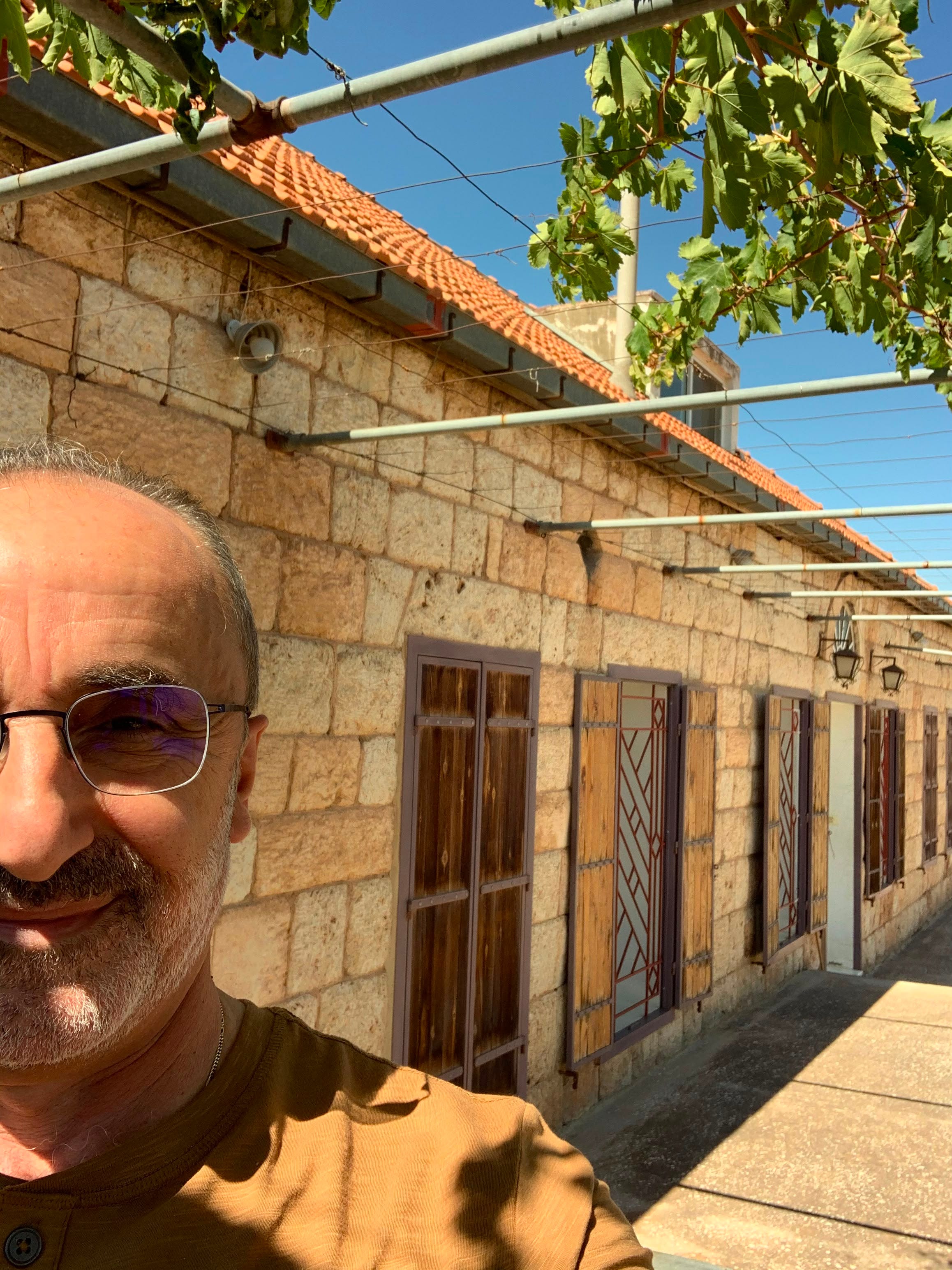
The selfie that Georges still uses as his WhatsApp profile picture was also taken during that same stayha, at almost the same angle, and it is the one that plays a role in the description below.
The Hand and the digits, 2003
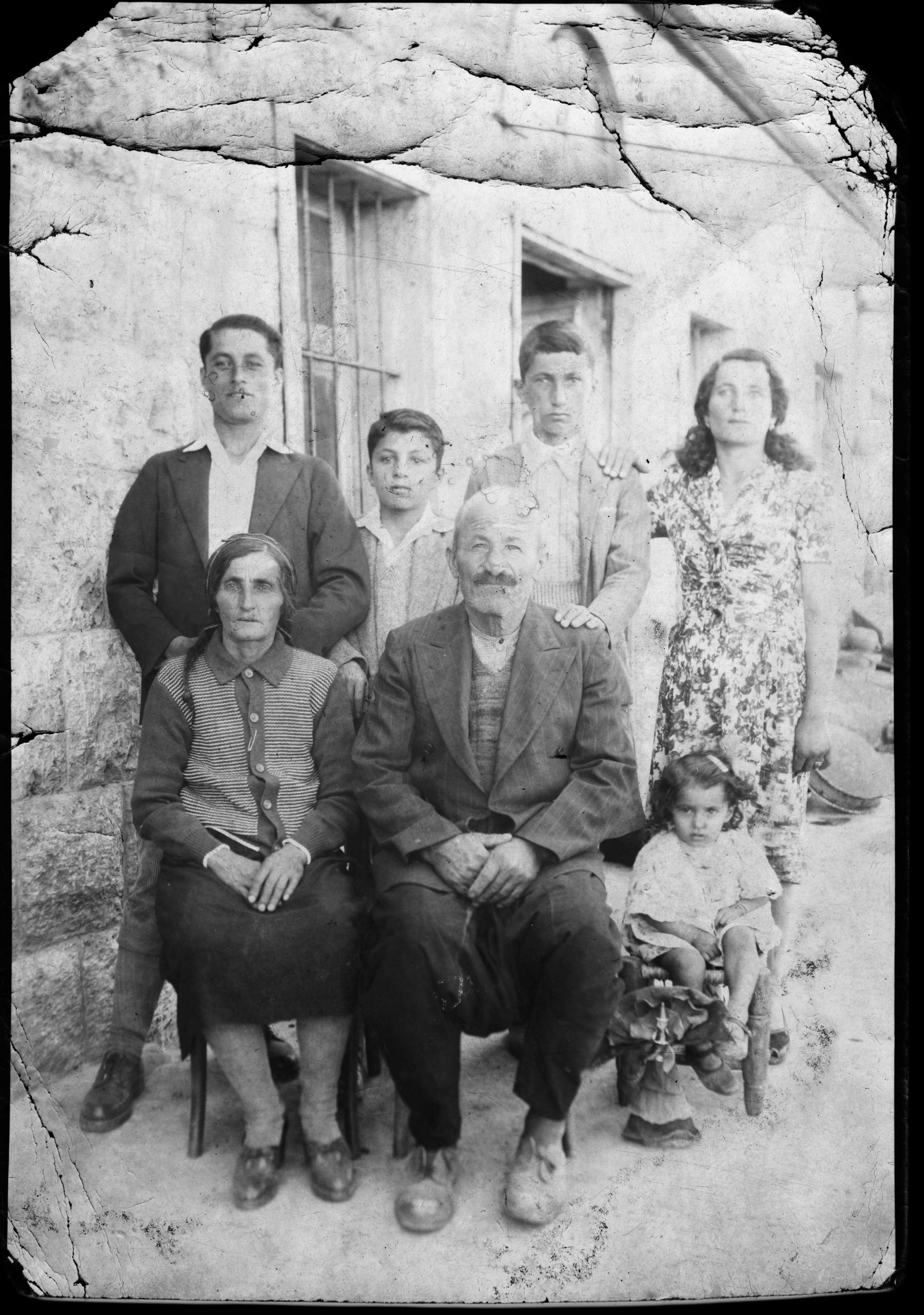
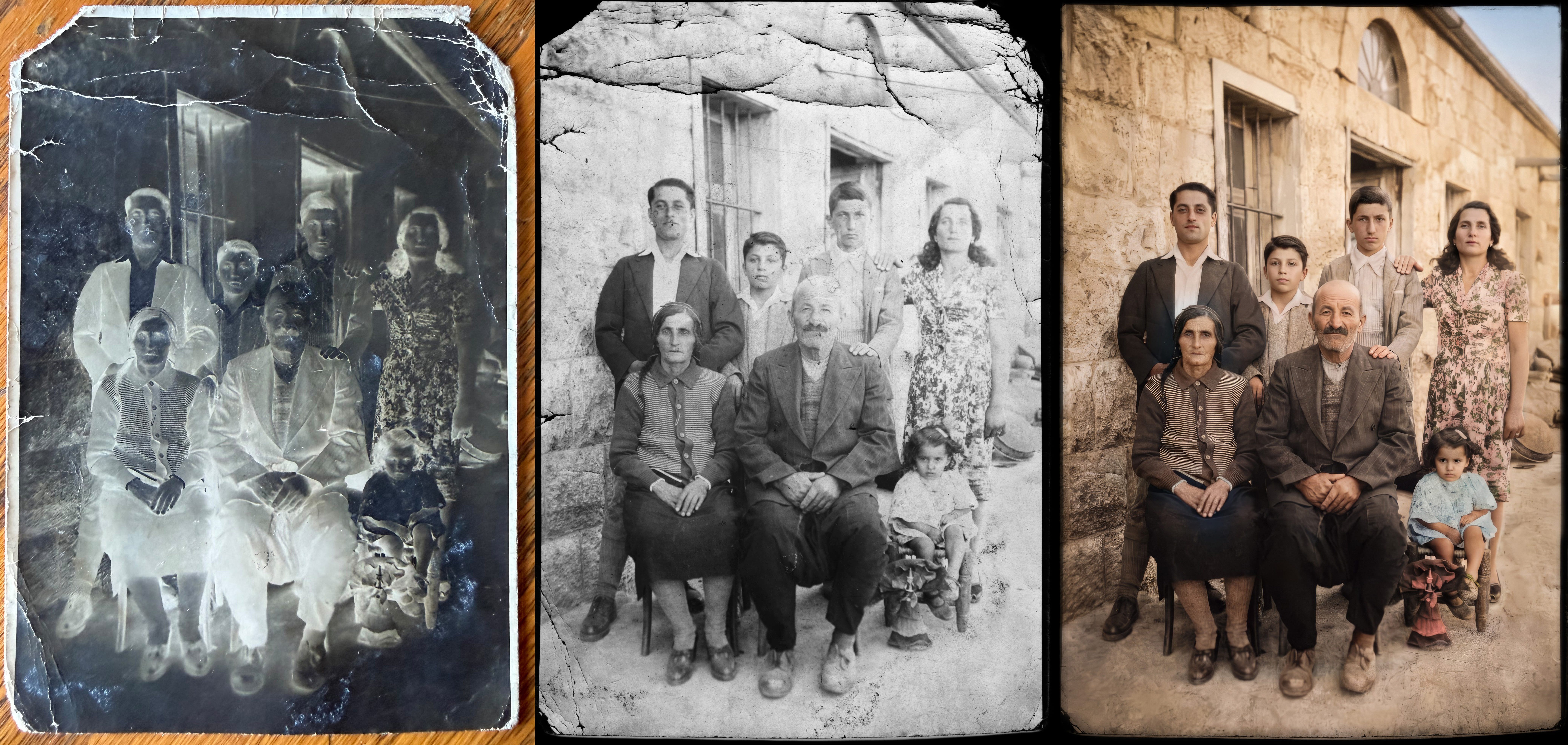
The first restoration was my own, performed in 2003, as Georges realized that, working in photography, I may know something which could help him. At that time I used the maximal resolution the equipment of that year allowed to scan the negative. I inverted it; the only non-interpretive step of the whole process, as far as the physics of tones go, a negative reversed into positive. Everything else: cleaning from the dust which the scanner itself put there, adjusting the paper density because of the spots where age consumed more silver than in other parts of the paper, was retouching in the narrowest sense of this word. The cracks remained. To close one, I should know what lies underneath it, and I had no way to know that, therefore the cracks remained in the 2003 print and in the print which is used now. I invented nothing which the paper did not contain, and the tool did not allow me to invent anything. Moreover, it was impossible to make some inventions, as I did not intend to create another document, I wanted to recover a document, therefore I only cleaned what lay between the paper and the eye.
Seven shadows became seven people. Joryous and Hanneh Nasrallah, the father and mother of the household, seated at the center, his hands folded, hers folded as well. Nicola, Ephrem and Youssef Nasrallah standing behind them, in this sequence, a young man, a boy of about eleven and an adolescent almost of his eldest brother’s height. Their sister, Adele Nasrallah, a young woman in a floral dress, her hand laying on Youssef’s shoulder. Salwa Nasrallah, Adele’s daughter, a little girl seated at the edge, her doll in her hand. Behind them, the family house. Nothing there had changed since 1946, but it had become visible.
That was important somehow. Later, Georges told me that it was the first time he, his cousins, and most of the extended family saw their parents’ and grandparents’ faces clearly, were able to read the expression instead of inferring one. The restoration which did not change anything in the information contained in the document changed everything about who could get this information.
Not a single moment of that work depended on 2003. It did not depend on a computer or a scanner or a curve. The contact frame and a lamp would perform the same procedure in 1946, as well as in every year in between. For fifty-seven years, something was missing from the object in that house. This something was never a technique. Someone had to realize that the object is a document, what Hanneh did not know, and to decide that a document can be opened, what nobody else did until Georges.
Archaeology does not add. It removes what had gathered between a surface and an eye in the order in which it had gathered, and it stops when the surface begins. All the recovered elements were there already, and all the removed ones are later than the object of search. An inversion and a retouch is just that. The 2003 restoration is an act of archaeology in the strictest sense of the word.
Later restoration does the opposite thing. It does not strip away the overburden. It replaces the parts taken away by the overburden, and those processes look almost identical. In 2003, the technology existed long before the photograph was made; all that was lacking was awareness of something being missing. In 2026, nobody needed to be informed about how incomplete the image was. What changed was the ability to fix the problem.
The Prompt, 2026
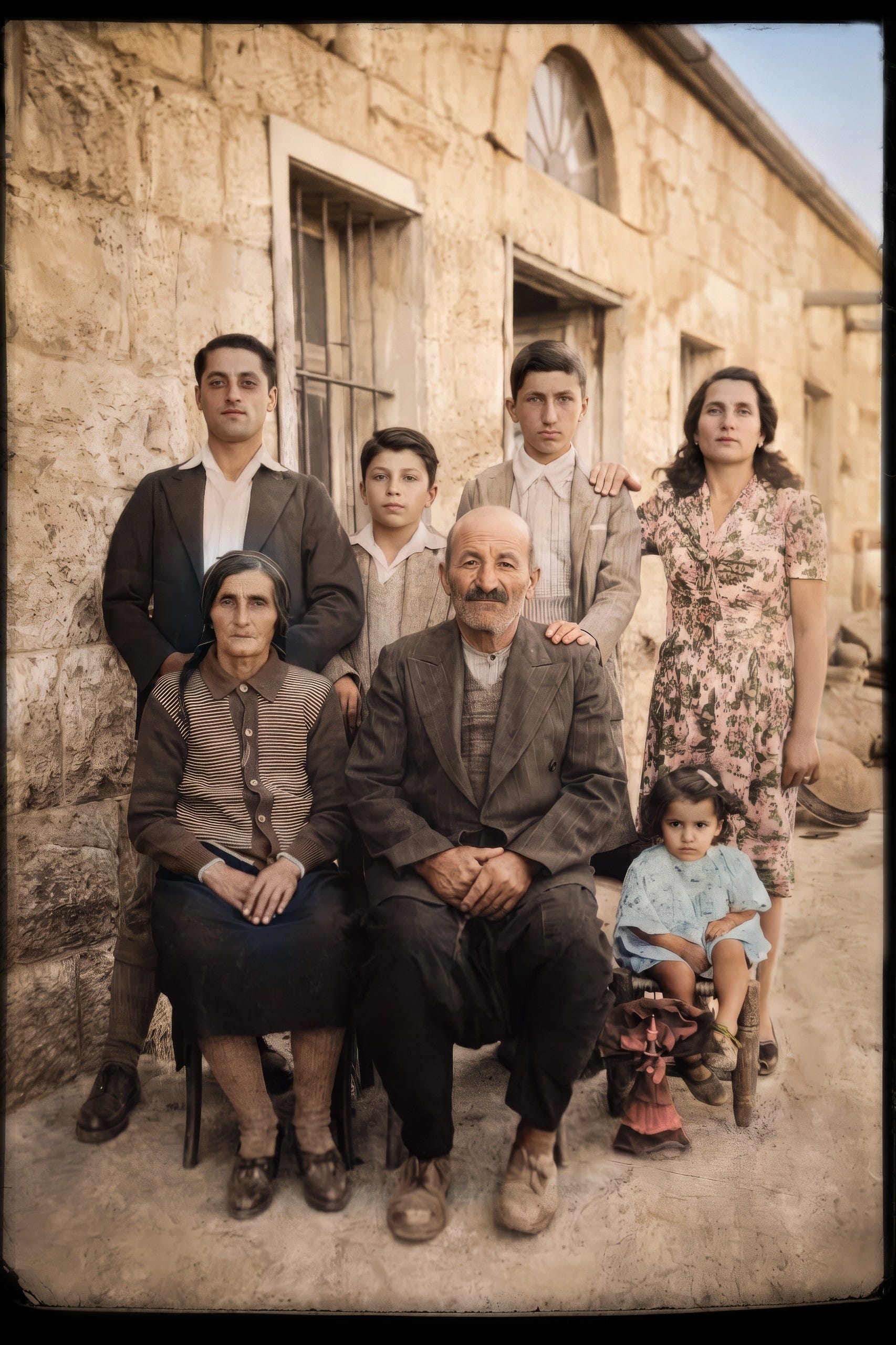
Georges returned to me in 2026, asking what more modern techniques can do with a document that had nothing left to offer after 2003. This time the tool wasn’t a scanner with its inversion curves but a generative model, trained on vast masses of photographs and tasked with inferring color, texture, and finer facial structure wherever eighty years of decay took a detail to a point where no retouching technique could possibly fix it, into places only statistics could cover.
Such a model has never seen this particular family. It has seen millions of others, and it does its work using statistical methods, looking for the most likely connection between what is left visible on the damaged paper and the general characteristics of the face grain on paper tends to make at a given angle, a given illumination and a roughly estimated age. It doesn’t know what particular grandfather’s face looks like. It just looks like it knows every other face out there. Unrestricted, a model like that creates what I referred to in one of my previous essays as a simulograph; an image that carries all the grammar of evidentiality and not a shred of guarantee behind it. Face reconstruction is probably the area where models of this kind create the most convincing and the most inaccurate results since whatever face is never seen statistically looks like a face.
What was supposed to prevent this restoration from crossing the line this time was not the model itself but Georges standing in the same photo’s background on the same terrace, seventy-three years later, sending me a selfie taken from that photograph. He used it as his profile picture for seven years by then, taking it for reasons that had nothing whatsoever to do with the task at hand and seen and recognized by every single person in the family. Most importantly, nothing in it was set up specially for this restoration project, which is why it worked. Everything, the stonework in the wall behind Georges, the proportions of the doorways, the color and grain of a house that Georges kept standing all these years provided the model with coordinates to stick to at every point where the two photos matched.
In the 2026 image, there is an arch: a semicircular fanlight with radiating glazing bars, in the wall above the doorway, Typical of Lebanese architecture. In the negative, the same section of the sheet looked like damage, a curved crack extending from the torn top, and in the 2003 print it reads as such, and as nothing else. The arch is real. The arch is there, on the house. A model has rediscovered an element which decay had obscured for eighty years, and it did so because a man has photographed his own wall in 2019 for no reason at all.
The same surface, produced in the same pass and rendered in the same voice, contains both an arch that is real and a jaw that is not. There is nothing in the image to make this distinction. What makes it is that a wall in the West Bekaa is still standing and can be visited, and Joryous Nasrallah cannot.
This is the problem with the overlap. The common feature of the two images is a wall. A terrace photographed in September 2019 can fix a doorway and the texture of a stone, but cannot fix a face, because it does not contain anything about the face. The faces are sitting before a wall that is now known to be real. The knowledge will not extend further. A viewer will see a real house, and assume a real grandfather, since the two appeared in the same picture and there is nothing to separate the two in that picture.
The ground truth had performed a more limited function than I had wanted it to. It established the context. It made the elements that were not in need of verification reliable, leaving the one that was essential exactly where it was.
The role of the house in this process was purely symbolic. What the house would get a stone at a time, being built by someone who knew which stones carry the load and which don’t, the photograph would get it all at once, from outside, from the tools that were unable to distinguish between the two and were never meant to. This is the real relationship between the two objects. It is not a form of evidence.
The Face
Difference between the two can be clearly noted in one of the faces. The 2003 version in black and white is worn down. There are pits on the skin, sunken cheeks, eyes narrowed to counter the afternoon sun and mouth trying to be either smile or strain. The 2026 version has well-defined cheeks, open and clear eyes while the ambiguity in the mouth has become warmth. There is nothing ambiguous here anymore.
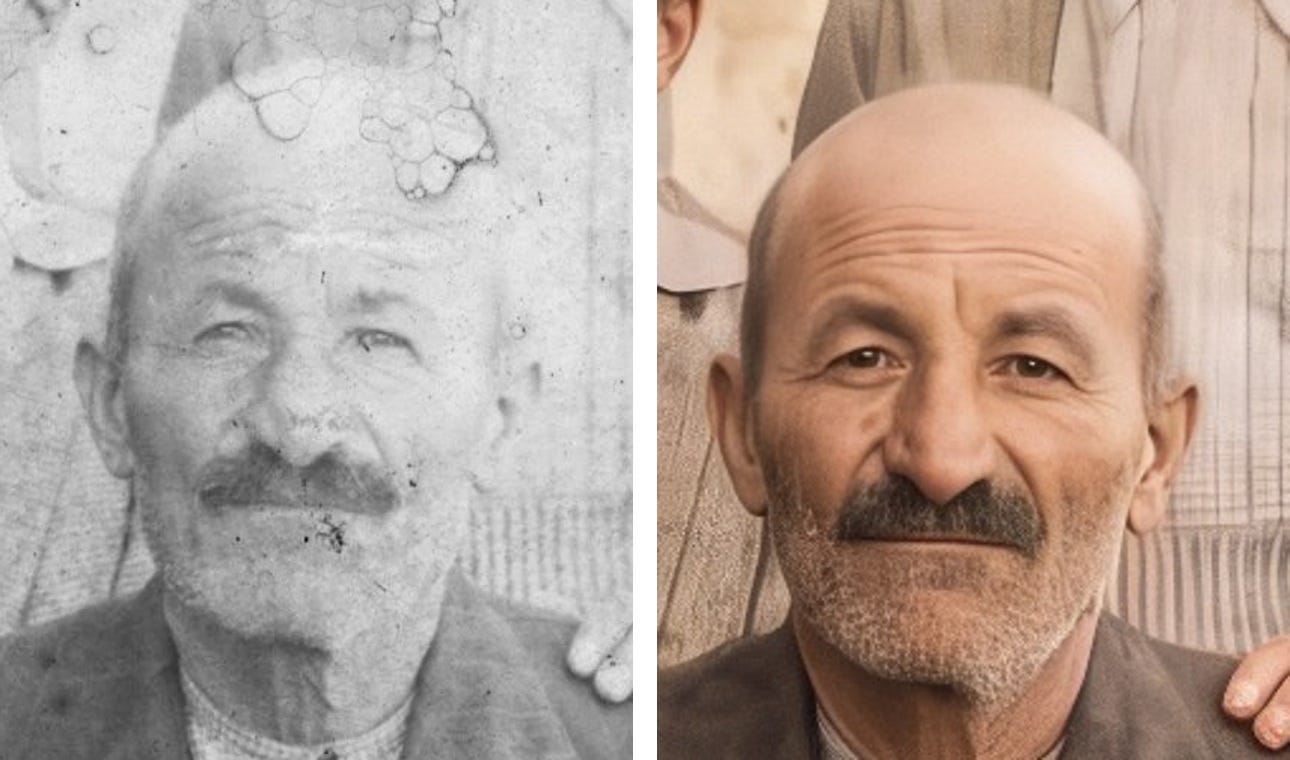
Have a look at the crown of his head. It is covered with liquid bubbles that are round and also there are cracks which are fine and it shows the damage done to the paper. The 2026 version is just a smooth scalp with a highlight on it. There is no removing of the damage by the model as it understood the damage as a head and rendered a head. Now have a look at the jaw. There is grey stubble, some individual hairs as well as skin texture which shows that there were grains of dirt in the paper. Whatever else the paper contained, there were no hairs in it.
It goes the opposite way as well. While on the jaw the model added something which the paper had not, on the dress of Adele the model removed something which the paper actually had. In the 2003 version the lower skirt had distinct rosettes with petals that could be easily identified while in the 2026 version there were just soft dabs in the same position. While face is worth resolution, dress is worth an impression. One rule leads to the same result in two cases but only one of them can be considered an error.
Call it an error or a fake will be too simple. That is the third perception of the same afternoon. Decay on the print and weather on a man are the same thing at the scale of a cheek and the removal technique used to get rid of the first will always result in finding the second. However, this direction of removal is not random. It goes towards legibility and good lighting as almost all photographs seen by the model were meant to be liked. The face cannot be unreadable in the result. Where the paper does not say anything, the output does not say anything either. It says something specific in the same voice that was used for the actual parts of the paper.
Memory of family is linear as well. A son replacing his dead father whom he knew when he was just twelve would not replace him worse than he was but will make him clear as he was. In 2026, what happened was a collision of two systems biased in the same way, one being statistical and another being filial, and both of them true.
Moreover, there is the color of the images that no black-and-white negatives have ever had. Salwa’s dress is blue. Adele’s is pink with green. Eyes of three men are pale grey. A neutral color tells nothing. It leaves the decision to the viewer, and every member of that family would fill it in with a face they know well enough. There is nothing in the paper about colors, and it has not been mistaken because it has not been asked anything about it yet.
The image still has its torn corners and darkened edges. The damage that was done to it proves all the things that were deleted from it, and all of the things that prove the age of hope.
The Form
There is a second factor contributing to the success of the image reconstruction, and it cannot be treated as evidence of trustworthiness. Nothing about the pose on the terrace was invented by those who stood there. Two people sitting in the middle, three sons standing behind, girl’s hand on one of the shoulders, child standing on the edge of the photo, everything was an arrangement offered by the village and confirmed by the photographer. This model has seen thousands of that arrangement. It has not seen this family once.
Therefore, the parts of the image that it could recreate with absolute certainty are the parts shaped by habitus and tradition. Position, shape of the sleeves, how collars of men of that social layer looked in the 1940s, the gap between the first row and the wall that photographer of that level kept. Model knows everything about it for the same reason this family knew, because nothing in it was chosen. The parts of the image that it could not rebuild were individual to these seven who stood on that day on the terrace, a shape of the mouth, the way Nicola and Youssef, who was at the opposite end of that row, positioned their shoulders. These are the only things that any member of that family searched for. Dispositions that made this family stand for the camera in 1946 were exactly the same dispositions that made it visible for the machine in 2026. The first parts of it that came back were those that were not personal for it.
The habitus acquired on the terrace went everywhere with all of them, mobile in a way that the terrace itself never could be. That is part of the reason why a restored photograph of the particular arrangement could be understood instantly by people who had never stepped foot on it. The disposition outlived the land that shaped it, and it is the disposition that the model turned out to have mastered.
Stone gave a certain permanence to the parts of the photograph that were undisputed. Georges held up the structure of the house. I reconstructed the image. I took my time to fine tune the prompt, getting better and semantically retouching each detail until the model responded with something I felt good about, and I doubt very much if the next version of this technology will require me to do that later on, so I might as well be clear about it now, while I still need to do anything at all. It was about an imperfect judgment about likeness, arrived at through comparisons and contrasts and imagination.
Both of those restorations needed approval before publication. Everything was approved by Georges. I reconstructed the image. Georges approved every single part of it, and Georges distributed the image. I did the reconstruction. Georges approved it and gave it away.
The Family Tree
The original negative resided in a single house in the Bekaa Valley for eighty years and did not reach many of the relatives of its family. The restored image was released into a WhatsApp family tree, and within seconds, from wherever they all live now, cousins and children and grandchildren were identifying a parent, a grandparent, for the first time recognizing a specific face among seven.
They all identified it. Not one of them checked it. They were seeing faces they know from resemblance, from old photographs, from family histories, from decades of practicing how to see. An image that confirms what a family knows about its faces will be identified regardless of its truthfulness.
Such family trees are in themselves the artifacts of diasporic experience, having been constructed specifically because such a spread-out family requires a shared room that does not depend on the presence of any family member in the same physical location. Names have been added to it in the same way that names were added to a family register, birth, marriage, and a cousin’s newly acquired contact details when he moved to another country once more. Sharing a restored photograph in a group like this is quite unlike showing it across a table to a member of the family. Instead, it is showing it in a room built out of absence.
The legibility that was regained with the 2003 restoration was regaled through this 2026 restoration. This was the thing for which the object was created and something that it had never done before. After eighty years of the photographer’s running out of glass plates, the photograph finally fulfilled the purpose for which it was originally made. And this time, the fulfillment came via a group chat rather than on the walls of a house, where there are no walls common to the family anymore.
There is no ceremony in this moment. The image is opened in the kitchen of someone outside Lebanon during an ordinary evening by someone, whose lit screen is impossible to distinguish from those hundred others produced daily. In doing this, this person would see a face that might have never been seen in full clarity, or not in decades. The most crucial recognitions for a scattered family come now dressed as nothing, wedged between a regular message and another.
The distance between this family and its image was closed to nothing by 2026 in just as much time as it took the phone to load an attachment. The distance between the members of the family and the ground on which their image was captured has remained the same. No restoration is capable of reaching it.
Salwa
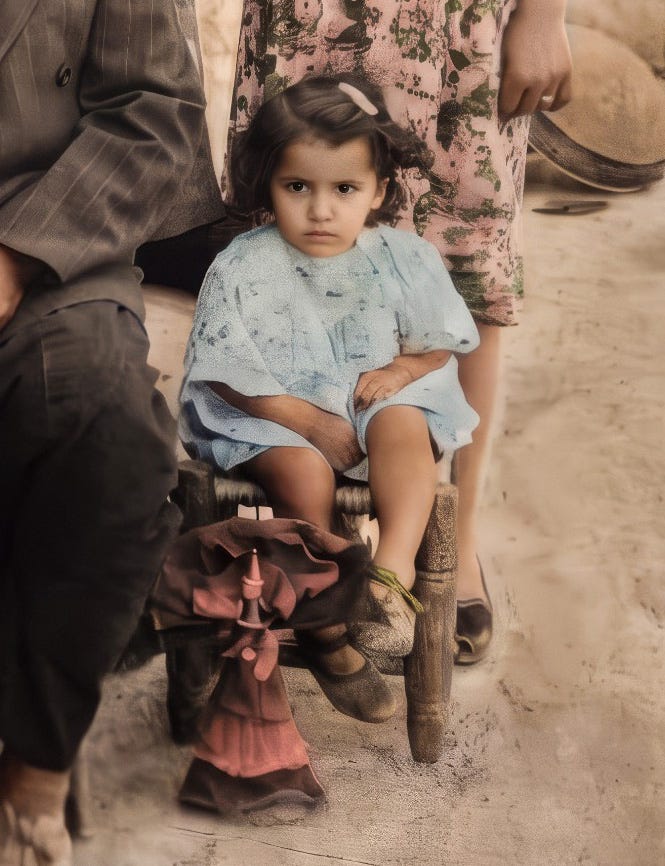
One of the people in that photograph lives on. The small girl seated on the edge of the frame holding a doll is Salwa Nasrallah who is now in her eighties and living in Brazil. She is Adele’s daughter, a granddaughter of the two seated in the center, and Georges’ first cousin.
There was Salwa, which should make her the single reader whose approval matters in a way that none of the others do, and she does not. She was three or four years old that afternoon on that terrace. She is the sole living witness, but she is the least qualified one to be such. She might remember the doll. She might look up into the face of her mother standing right behind her in a floral dress, and she has nothing to compare it to other than the very same photographs and very same stories that all the rest have been relying on for eighty years.
And there is no verifier. There was never going to be one. The 2003 print is checkable because the negative exists and every single mark in the print can be traced back to it. The 2026 image is checkable only against a memory and the memory still available from that afternoon belongs to a woman who was just a child at the time and who hasn’t seen the picture yet. She doesn’t have WhatsApp. Georges hasn’t kept in touch with her for several years now. No one went to find her after the restoration.
Custody
No grandfathers returned home from death. No fathers, passed away long before Georges turned twelve, got back to testify on their behalf. What was returned was a narrower and more truthful thing: an opportunity to recognize them again, an overwhelmingly common experience of looking into a face and recognizing whose it is. That comes pretty close to all that a photograph used to promise once you strip it off of all the grand things people claim about it.
The restored face poses a question to the people receiving it and the answer to it is neither gratitude nor verification. It is rather custody. Once the face of this particular sort is restored for the family, someone needs to make a decision regarding what happens to it next, who sees it, who knows about it, whether it gets hung on a wall or exists solely in a phone, whether the story about the paper running out, grandmother giving the negative to America, and the grandson opening the box gets told along with it or is left out quietly. This kind of custody didn’t exist while the negative remained unreadable. Now it does and it includes a thing the family has never had to deal with before. The image retains its value as long as no one demands anything from it. And I haven’t.
What the family possesses is not one image existing in three states. These are three separate things and they respond differently. The negative is the evidence. It can be examined again and will say the same thing to whoever holds it up to the light; to many almost nothing. The 2003 print is the interpretation and every single mark on it can be traced back to whatever the paper used to hold on to, making it arguable. The 2026 image is a proposal. They possess a document that is impossible to read, an interpretation that no one disputes and a proposal that everyone believes. And it is also the only one of those three to contain two dates: an afternoon in 1946 and the day in 2019 when Georges stood on that very terrace with a phone, fusing into a single plane and presenting itself in its entirety as 1946.
The paper captured the afternoon. A hand returned that which the paper held. A machine, leaning in the same direction as the family, restored that which the paper lacked. A twelve-year-old boy, whose father had died early, made decisions regarding whatever returned. The object remained constant. What shifted was the demand each present placed on the object, and what it would give up as an answer. Archaeology has always been that, each present asking of the past using its instruments, receiving from the past what it allowed. The difference today is that our instruments do not only discover. They also provide.
Salwa was three or four years old when she was photographed on that terrace. She is now in her eighties, she lives in Brazil, nobody has her phone number anymore, and she has not seen the photograph. She could look at it and know the exact color of the dress she wore. She could look at it and see only what she has been told for eighty years. In either case, she would be the last of it. For now, nobody has moved.